Basecamp: the king of collaboration
Share this:
The difference between a good custom website and a great one comes down to collaboration.
When the flow of information between client and development team is fluid; when it can be intuitive enough to handle modern digital media and utilities, something incredible happens. The website becomes more than a designer’s vision. More than a developer’s code. More than a writer’s content. You walk away with a product that brings all of these components together with a unique market experience, and binds them into a truly superior digital experience. Our business at Headspace is delivering those experiences, and to do so we need the best collaborative software. We need Basecamp.
It all started in 2003 for 37Signals, a small web application company who were on the verge of completing a work management solution for their in-house needs. They needed a better way to manage their clients, and when the current portfolio of options couldn’t scratch their itch, they built their own answer. It wasn’t long before the team realized they had struck gold, and Basecamp emerged on the market in 2004 as a tried and true success before it even had its first buyer.
The launch was a massive success. 37signals quickly dropped their other projects and focused solely on developing their once in-house productivity solution that was now vying for best project management suite. Fast forward 11 years and Basecamp has become a juggernaut in the space, with over 9,000,000 users and a roster of well-known brands backing the system, including Adidas, Nike, and Twitter. Not too shabby, for a business of 43 employees.
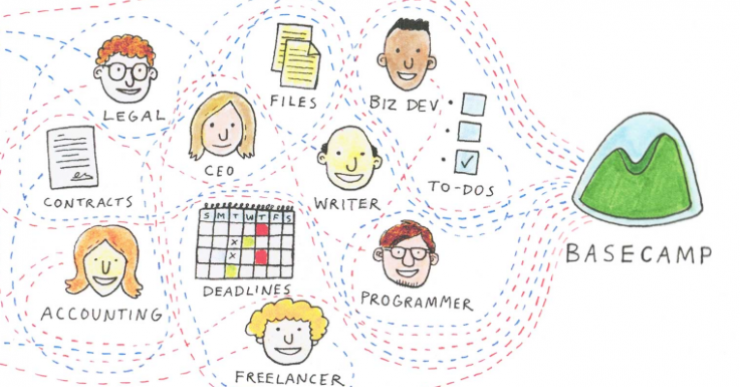
Here’s how it all breaks down: Basecamp separates all of your priorities and communications by project, company-wide. Adding employees and clients to a project is as easy as sending them an entry email, and from there assigning to-dos to a project or an employee is a breeze. Calendaring, catalogued discussion forums and intuitive update emails all come out on the other side as an organized library of collaborative efforts, built into a user-friendly interface. As they say on the Basecamp website: ‘No IT Department required’.
Just about every industry that leans on documented communications (are there any left that don’t?) has dealt with the predicament of a misplaced item, and how quickly that situation devolves into problems. Basecamp’s solution to this is a thoroughly developed search functionality that can direct you to people and documents alike based on keywords in search queries. If you’re vigilant in your use of the system, you may never lose another note or email again, and that’s truly invaluable.
From a client’s perspective, Basecamp is the ultimate window into a transparent relationship. Project progress, immediate communication and a backlog of documents and conversations is useful to both parties, but at the end of that road is a degree of inclusion and transparency that you can’t really reach with email – a front-row seat to the show.
As if the built in functionality we’ve talked about wasn’t enough, Basecamp plays nice with the tools you use every day. A healthy roster of plug-ins positions Basecamp as the ultimately plug and play utility, as many storage options, time-tracking services, and other productivity utilities can combine to conquer much of your workflow.
It’s a good story, and one we’ve invested in. 37signals has a real winner on their hands, and we have yet to come across a service that’s as refined and functional as Basecamp. It makes us happy and our clients happier, so we’re happy to sing its praises.
Comments
comments powered by Disqus